A prescription that lives on your shelf, beside the rest of your routine.
- Applied at home
- Fits a skincare routine
- Provider reviewed
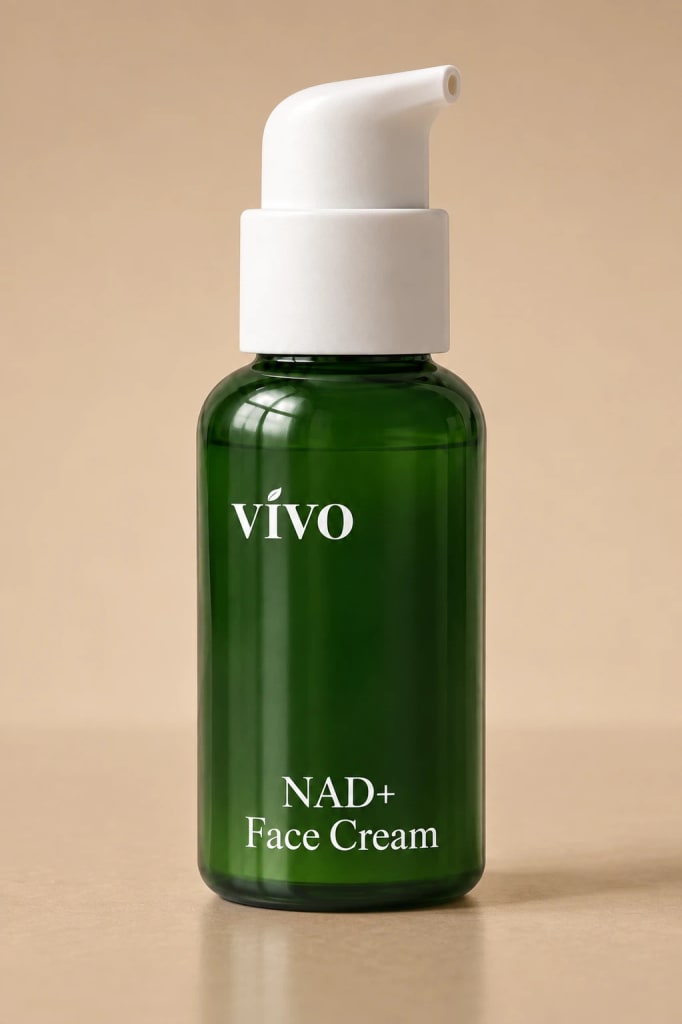
NAD+ biology, applied topically.
A compounded prescription cream containing nicotinamide adenine dinucleotide (NAD+), available after evaluation by a licensed provider.
Standard price $129$109 first month
The formulation shown is subject to your prescription and pharmacy availability.
What’s included
Prescription required. Subject to provider approval. Compounded medications are not FDA-approved.

A prescription that lives on your shelf, beside the rest of your routine.
Your skin is metabolically active tissue. Skin cells need energy and take part in processes involving cellular maintenance, turnover and responses to environmental stress.
NAD+ is a coenzyme naturally present in cells throughout the body, including skin cells, and takes part in fundamental cellular processes:
Cellular energy
NAD+ takes part in reactions involved in cellular energy metabolism.
Cellular signaling
NAD+ serves as a substrate for enzymes involved in cellular regulation.
DNA maintenance
NAD+-dependent enzymes take part in pathways involved in cellular responses to DNA damage.
Redox biology
NAD+ and NADH take part in redox reactions fundamental to cellular metabolism.


NAD+ (nicotinamide adenine dinucleotide) is a coenzyme found throughout the body. Cells use it in reactions involved in energy metabolism and as a substrate for enzymes involved in cellular signaling and maintenance.

The questions people ask most. Open any one for the details.
The outer layer of skin is a barrier. A widely cited dermatology perspective holds that molecular size limits what can pass through it, and researchers study vehicles and delivery technologies as ways of changing what reaches the skin.
How effectively intact NAD+ penetrates human skin from a given topical formulation is still being studied.
Whether a topical ingredient reaches its intended site depends on factors including:
NAD+ biology has generated interest in dermatology and skin-aging research. But the clinically important question isn't whether NAD+ matters to skin cells. It's whether this topical formulation has been shown to produce a visible result, and that is where the evidence becomes much more limited.
A cream is an active ingredient in a base. The base itself may contain ingredients that influence moisturization, hydration or skin feel independently of NAD+.
Vivo will describe what the cream base does only once the pharmacy's complete formulation has been verified, and will explain the role of each ingredient separately from NAD+. Until then, this page makes no hydration or barrier claim for the cream.
NAD+-related biology has been investigated in skin research, but much of the topical clinical evidence involves niacinamide, an NAD+ precursor, rather than intact NAD+ cream. Niacinamide has a substantially larger clinical literature on pigmentation and skin-aging endpoints.
A small 2026 prospective case series reported improvement in melasma after microneedling followed by topical sterile NAD+. It involved 36 patients, had no control group, and used a microneedling-assisted procedure rather than ordinary daily cream application. It is not evidence for everyday use of a cream.
Your provider can help determine how your prescribed cream fits into your existing routine.
Tell your provider what you currently use, including:
The process

The process starts with an online medical intake. A licensed provider reviews the health history submitted and, if appropriate, issues a prescription. Review is asynchronous by default. Some states require a synchronous visit, and a video visit may also be required if clinically indicated.

The prescription is prepared by a licensed US compounding pharmacy for the individual patient and shipped discreetly, with directions for use from the prescribing provider.

After delivery, patients can message the care team and a licensed provider through the patient portal. Continued refills require periodic provider reassessment.

There isn't a clinically established timeline in which compounded NAD+ Face Cream should be expected to produce a particular cosmetic outcome.
A compounded prescription cream containing NAD+ (nicotinamide adenine dinucleotide), prescribed by a licensed provider after an intake and prepared by a licensed compounding pharmacy.
No. Niacinamide (nicotinamide) is a form of vitamin B3 that the body can use to make NAD+. It is a different, smaller molecule with its own research literature, and findings about niacinamide don't transfer to NAD+ cream.
No. Nicotinamide mononucleotide (NMN) and nicotinamide riboside (NR) are precursors the body can use to make NAD+. They are different compounds, and research on them isn't evidence for topical NAD+.
As in cells throughout the body, NAD+ takes part in redox reactions involved in energy metabolism and is used by enzymes involved in cellular signaling and responses to DNA damage. Those are roles of the body's own NAD+, not demonstrated effects of applying it to skin.
It depends on the formulation: the molecule, concentration, base, stability and the condition of the skin barrier all matter. How effectively intact NAD+ penetrates human skin from topical formulations is still being studied.
Vivo doesn't claim it does. Compounded topical NAD+ has not been shown in clinical studies to reduce wrinkles or fine lines.
Vivo doesn't claim it does. NAD+ biology in skin cells doesn't establish that applying an NAD+ cream increases collagen, and there isn't product-specific evidence that it does.
Whether compounded topical NAD+ improves firmness or elasticity hasn't been established. Vivo makes no firmness claim for it.
NAD+ and hydration aren't the same thing. Any moisturizing effect would come from the cream base, and Vivo will describe the base only once its complete formulation has been verified with the pharmacy.
Vivo doesn't claim it does. There isn't an established cosmetic outcome, including brightening, for compounded topical NAD+.
Vivo doesn't represent NAD+ Face Cream as a treatment for hyperpigmentation, melasma or any other skin condition. If you have a skin condition, tell your provider; it may deserve its own evaluation.
They are different routes and formulations intended for different treatment contexts: the cream is applied to the skin, and the nasal spray (see the NAD+ Nasal Spray page) is used intranasally. One shouldn't be assumed to produce the effects of the other.
That's a decision for your provider, based on your intake and treatment goals.
Ask your provider. Guidance depends on your prescription, the formulation and the rest of your routine.
Ask your provider. Guidance depends on your prescription, the formulation and the other products you use.
As your prescription directs.
The amount your prescription specifies. Don't change it without talking to your provider.
Follow the storage instructions on your prescription label and from the dispensing pharmacy.
There isn't a clinically established timeline in which compounded NAD+ Face Cream should be expected to produce a particular cosmetic outcome. Individual experiences vary.
No. Compounded medications are not FDA-approved, and FDA does not review them for safety, effectiveness or quality before they are marketed.
Yes. NAD+ Face Cream is available by prescription only. Every order starts with an online medical intake and review by a licensed provider, who determines whether a prescription is clinically appropriate. Patients must be 18 or older and physically located in a state where services are available, both at intake and at each refill. Services are currently available in all 50 US states, subject to state regulation.
A card may be authorized at checkout and is charged only after a provider approves a prescription. If a licensed provider determines the medication is not clinically appropriate, no prescription is issued, no medication ships, and no charge is completed for that medication order.
Provider review is asynchronous by default, based on the written intake. Some states require a synchronous visit (live video or phone) before a provider can prescribe, and a provider may also request one if clinically indicated.
Prescriptions are issued by licensed providers. Medical leadership includes Dr. Sean Arora, M.D., and Dr. Shannon Arora, M.D. Prescriptions are prepared and shipped by a licensed US 503A compounding pharmacy. Vivo Health LLC operates the platform and does not practice medicine or dispense medication.
No. NAD+ Face Cream is a compounded medication prepared by a licensed pharmacy for an individual prescription. Compounded medications are not FDA-approved drug products.

Explore NAD+ Face Cream through a provider-guided process.
Standard price $129$109 first month
Vivo is a telehealth platform and does not manufacture or compound medications. Treatment requires evaluation by a licensed healthcare provider. A prescription is issued only when the provider determines treatment is medically appropriate.
Compounded medications are not FDA-approved. FDA does not review compounded medications for safety, effectiveness or quality before they are marketed. Compounded medications may be prescribed when a healthcare provider determines that a compounded preparation is appropriate for an individual patient.
Information on this page is educational and does not replace individualized medical advice. Treatment availability, formulation and fulfillment may vary based on provider judgment and pharmacy availability.